Key Lessons from Wesley Dunn on NDAs, Trade Secrets, and CBI

Key Lessons from Wesley Dunn on NDAs, Trade Secrets, and CBI

Wesley Dunn, Senior Counsel at Potomac Legal Group, recently co-led a high-level Continuing Legal Education (CLE) session, titled “Enforceable Nondisclosure Agreements: Protecting Trade Secrets.” As an experienced litigator with a deep background in both federal service and private sector employment law, Mr. Dunn addressed a legal landscape where the traditional, broad-reaching nondisclosure agreement is under increasing pressure from both judicial and regulatory bodies. The session focused on the transition from using generic, boilerplate templates to

Read More...

New Bill Seeks to End Coercive “Stay or Pay” Employment Contracts in Virginia

New Bill Seeks to End Coercive “Stay or Pay” Employment Contracts in Virginia

The Virginia General Assembly is taking a new aim at “Stay or Pay” contracts, which have long plagued employees in positions that require significant job training or relocation.  Formally known as Training Repayment Agreement Provisions (TRAP), the agreements have come under intense scrutiny for their role in restricting worker mobility and creating a cycle of financial coercion. With the recent passage of House Bill 923, Virginia is positioned to join a growing movement of states

Read More...

Potomac Legal Group Sponsors Maryland Women’s Leadership Event

Potomac Legal Group Sponsors Maryland Women’s Leadership Event

Potomac Legal Group proudly supported and sponsored The Maryland Commission for Women’s Annual Women’s Legislative Briefing, held recently, at the Universities at Shady Grove. The Women’s Legislative Briefing brought together policymakers, advocates, community stakeholders and leaders to address issues affecting women and girls throughout the state. The event featured a keynote panel of groundbreaking women: United States Senator Angela Alsobrooks, Maryland Lieutenant Governor Aruna Miller, and Maryland Speaker of the House of Delegates, Joseline Peña-Melnyk.

Read More...

Maryland Withdraws “AI Tax” Bill for Worker Displacement

Maryland Withdraws “AI Tax” Bill for Worker Displacement

As artificial intelligence and robotics move from science fiction to the office floor, the Maryland General Assembly is grappling with the difficult question of who pays for the human cost of automation.  House Bill 314, also known as the Automation Technology Deployment Assessment, was introduced by Delegate Vaughn Stewart to create a safety net for workers displaced by the very technology intended to increase efficiency. While the bill was recently withdrawn by its sponsor as

Read More...

New Maryland Proposal Targets Employee Noncompetes During Business Relocations

New Maryland Proposal Targets Employee Noncompetes During Business Relocations

Newly proposed legislation in the Maryland Assembly would declare noncompete and conflict of interest clauses null and void for employees during certain business transitions. The legislation, now SB 900 in the Senate, would apply to businesses that relocate their principal place of business outside of Maryland, reorganize in a way that fundamentally alters their Maryland footprint, or cease the majority of their operations within the state.  Maryland has already implemented several layers of noncompete protections

Read More...

New Bill in Virginia Defines Sales Commissions as Wages, Retroactivity Not Included

New Bill in Virginia Defines Sales Commissions as Wages, Retroactivity Not Included

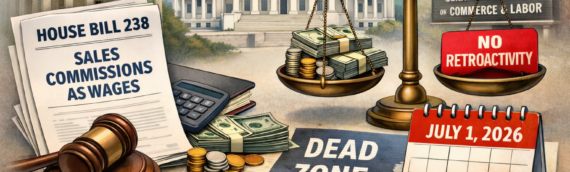
The critical legislative battle continues unfolding in the Virginia General Assembly, as lawmakers move to close a legal loophole that has left the Commonwealth’s vast sales force vulnerable to wage theft. House Bill 238, introduced during the 2026 legislative session, has officially advanced through the House of Delegates with a 64-35 vote and is now headed to the Senate Committee on Commerce and Labor. The urgency follows a December 30, 2025, ruling by the Virginia

Read More...

New York’s “Trapped at Work Act:” Bans on Stay-or-Pay Agreements

New York’s “Trapped at Work Act:” Bans on Stay-or-Pay Agreements

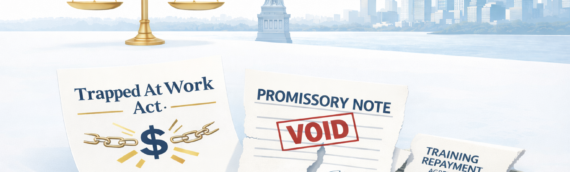
New York has taken a decisive step toward increasing worker mobility and limiting restrictive employment practices with the enactment of the Trapped at Work Act. Signed by Governor Kathy Hochul on December 19, 2025, this legislation effectively curtails the use of stay-or-pay agreements, which are contractual provisions that require workers to repay their employers if they leave their jobs before a specified period. These agreements, often framed as reimbursement for training or onboarding costs, have

Read More...

Employment Non-Competes in Washington, D.C.: Updates for 2026

Employment Non-Competes in Washington, D.C.: Updates for 2026

If you work in the District of Columbia, your right to move between jobs or start your own business has never been better protected. As of January 1, 2026, new updates to the District’s ban on non-compete agreements have further raised the bar for employers, making it even harder for companies to legally restrict your professional mobility. For the vast majority of D.C. workers, non-compete agreements are now void and unenforceable. This means that if

Read More...

Act Now: Virginia Sales Commissions Are No Longer Protected

Act Now: Virginia Sales Commissions Are No Longer Protected

Salespeople in Virginia are in trouble. Due to a recent Virginia Supreme Court decision, sales commissions in Virginia are no longer considered wages under the Virginia Wage Payment Act. The decision is a jolt to any salesperson with a commission plan that falls under Virginia law, as it removes the primary means of full recovery, and it ends substantial employer penalties for withholding earned but unpaid commissions. The decision rips the teeth from the statute

Read More...

New 2026 California Employment Laws May Impact Remote Workers

New 2026 California Employment Laws May Impact Remote Workers

A wide-ranging set of California employment laws took effect on January 1, 2026, with additional notice-related requirements rolling out early in the year pursuant to multiple statutory amendments to the California Labor Code and Government Code.  The changes affect compensation transparency, equal pay enforcement, certain employment contract provisions, workplace notices, and layoff disclosures. While the laws apply broadly, they are particularly relevant to employees and employers in the technology, startup, and finance sectors, where compensation

Read More...